
The post How to Reduce intolerable Dog Barking at Home appeared first on Goldmark Property Management Blog.
]]>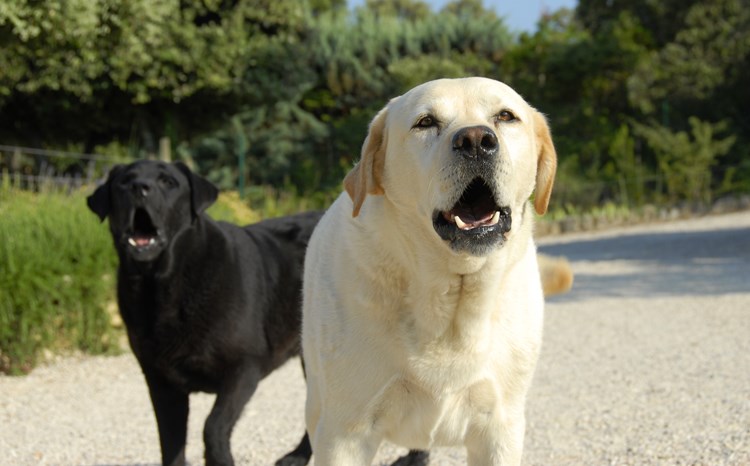
If your dog excessively barks at people passing by or noises outside, this disturbance can aggravate you and your neighbors. To improve your dog’s behavior, we reached out to the professional dog trainers at Vigilant K9 to learn more about their tips and tricks to reduce this intolerable noise. Kayleigh Omang from Vigilant K9 is a dog trainer and a certified AKC Evaluator. She shared her expertise on how to help stop or prevent excessive barking in dogs. Check out our interview with her below.
What are common reasons dogs excessively bark?
Dogs excessively bark for a few reasons. Usually, this is due to under stimulation. They haven't been given an appropriate outlet and they are barking out of boredom. I like to say a fulfilled dog is a tired dog. It could also be that you just haven't told your dog that it's inappropriate to bark. Dogs like black and white rules, so making sure you're correcting your dog for barking. Rewarding your dog for not barking is a big part of it, too!
Is all barking considered bad?
I'd say it depends on who you ask. Over arousal/excitement can cause barking, and some breeds are noisier than others. I like to give my dogs a time and place to bark because I often encourage that high drive in my own dog and want her to be excited about the work she's doing. However, it's only allowed when she is training or working. For example, the kennel or in the house is not a place to bark and it's never tolerated or allowed in my house.
How do I know if my dog has a barking problem? What are some common signs?
If it bothers you or you’ve received complaints, then it's probably a problem! You set your own rules for your dog, not the other way around. If you're bothered by it, contact a trainer to help you curb this behavior.
What does the training process look like to reduce the amount my dog barks? What is your number one tip?
It depends on the dog. Some dogs do well with a stern “no” verbal correction when they are barking. Others need a more slow and steady process of rewarding for being calm and slowly adding in more and more distractions they would normally bark at.
What would you recommend as a reward for dogs during the training process?
Whatever your dog works for! Some love their kibble, some need a better training treat. Others love toys and some will train for praise! We encourage you to always reward your dog for their hard work with whatever they find valuable.
What type of environment is best for this type of training?
All environments! A well-socialized and well-trained dog should be ready to train in all scenarios. If you're still working up to that level, it's good to start in home, then in a controlled environment, then in a park, and finally a dog-friendly store.
How long does this training typically take?
It's on a case-by-case basis, since all dogs are very different.
Do you have any advice for owners who live in an apartment and are struggling with this noise issue?
Hire a trainer. They can help troubleshoot why your dog is barking and what steps are necessary to get to the end goal. Because of this, if your dog barks excessively, it's important to remember that hiring a trainer won't be a quick fix. If you're getting noise complaints, we can't guarantee that will stop after a few weeks of training. It takes 4-6 months of constancy and routine to create a learned behavior. So, if your dog has learned to bark in certain situations and has been allowed that for the last year, then changing that learned behavior to a different one will take time.
My dog no longer barks while in our home. What should I do if my dog barks at strangers or other dogs in public?
Work with what we call zones. This means that you want to work away from distractions and move in closer. I like to compare zones to a stoplight. A green zone means the distraction is far enough away that your dog doesn't pay much attention. A yellow zone is where the "training" happens. You might get a woof here and there, but you are able to control your dog and recapture their attention. Stay out of a red zone, that means you're too close to the distraction and you've lost all your dog's focus and need to move out of that zone in order to gain him back.
Vigilant K9 is located in Fargo, ND and is owned by Head Trainer, Allison Case. Allison graduated from Starmark School for Dog Trainers in 2013 and started her business soon after. She owns an 8-year-old Malinois/GSD mix named Niko, who is a certified Human Remains Detection Dog for Valley Water Rescue. Allison and Niko recently competed together on A&E America’s Top Dog!
Interested in some training for your pup? Vigilant K9 specializes in training for basic and advanced obedience, scent discrimination, and puppy foundations. You can learn more about them on their website: https://www.vigilantk9-fm.com/
The post How to Reduce intolerable Dog Barking at Home appeared first on Goldmark Property Management Blog.
]]>The post Prepare for Your Pet appeared first on Goldmark Property Management Blog.
]]>
Preparing for a puppy or kitten is a must and caring for them is no walk in the park! Making sure you have the right items to get you through potty training, teething, and teaching them tricks is important. Check out the following items that are great to have before bringing a pet into your home.
- A crate or kennel – blanket or dog bed to go inside of it
- Food and water bowls
- Dog food – talk to your veterinarian about what food they think is best for your pup
- Small dog treats
- Collar and ID tag
- Harness and leash
- Toys – Chew toys, plush toys, and fetching/active toys
- Dog toothpaste
- Dog shampoo
- Brush or comb for grooming
- Cleaning supplies – urine stain remover, vacuum for shedding dogs
- Dog waste bags
- Potty training pads
- Food and water bowls
- Cat food – Talk to your veterinarian about what food they think is best for your kitten
- Treats
- Cat bed
- Carrier
- Litter box and litter
- Cat scratcher
- Toys – interactive toys and Catnip toys
- Cat tree or perch
- Collar and ID tag
- Cleaning supplies – urine cleaners, odor eliminators
Be sure to puppy/kitten proof your home! Keep your pet out of areas that might contain hazardous materials such as chemicals under the kitchen or bathroom sink, or things that could lead to an unsafe situation such as a stair case or wires behind the TV. Baby gates are great to use to block off areas that you don't want your pet to enter.
The post Prepare for Your Pet appeared first on Goldmark Property Management Blog.
]]>The post Ask an Expert: How to Potty Train Your Dog appeared first on Goldmark Property Management Blog.
]]>
Potty training a dog of any age can be overwhelming, frustrating, and emotional for both you AND your pup. When you add living in an apartment as a factor, potty training can be downright stressful. We talked to Kish from Down Dog Studios, a dog training center in Fargo that focuses on positive reinforcement to help dogs and dog owners live a happier life together.
We asked Kish a few questions about potty training and some tips and tricks she’s learned (and taught) over the years.
WHY DO DOGS HAVE ACCIDENTS?
A new puppy or dog doesn’t inherently know where it is expected to potty. It is up to the humans to monitor the pup or new dog at all times and take the pup out to the designated potty spot on a frequent and predictable schedule.
Even dogs you’ve had in your family for awhile can become confused when you move to a new home or apartment. A little retraining might be necessary to let your pup know when and where they need to go.
WHERE TO START WITH POTTY TRAINING?
Step one is prevention of the potty accident. This means keep your doggo in a confined, yet comfortable area or kennel when you can not fully supervise the dog. Even if it is just for a minute.
At first, this requires a lot of time and patience, but it will all pay off! The more consistent and predictable you are, the faster and easier potty training will go!
Keeping the pup on a consistent feeding, potty, and exercise schedule will help you predict when the dog has to go to the bathroom, and help the puppy get used to when and where it is supposed to potty.
WHEN AND HOW OFTEN DO I NEED TO TAKE MY DOG OUTSIDE?
A pup can hold their bladder/bowels for one hour per month of life, plus one. For example, a two month old dog can “hold it” for at most 2-3 hours. However, if a dog is very active, they will need to go potty sooner. An active body means an active bladder.
Young pups often don’t know their bladder is full until it is too late. So happily interrupt a play session and get your pup outside for a potty break instead of waiting and wondering if they need to go. When they wake up from a nap, even if it was a short nap, quickly take them outside for a potty break.
If you notice any body language indicating your pup is looking for a place to potty (sniffing the ground, circling, leaving the room), praise them for these indications as you quickly encourage them outside.
If your dog routinely comes inside after going to the bathroom and has an accident a few minutes later, do not take them off leash or let them out of your sight after you come inside. Take them back out a few minutes later and offer another potty break.
HOW LONG DOES POTTY TRAINING NORMALLY TAKE?
Puppies are not normally 100% potty trained before 6-8 months of age. Each week, you should see progress, but expect some potty accidents.
Potty training regression happens when the humans become more relaxed with monitoring of the pup’s feeding and potty schedule. If potty training takes a step backward, don’t panic! Go back to the basics of strict monitoring and frequent and regular potty breaks.
If there is still no improvement consult with a Veterinarian to rule out medical concerns that may be causing issues.
Also consider when the accidents are happening. Stress, fear and over excitement can cause pups to have accidents.
DO YOU AND HOW DO YOU DISCIPLINE A DOG THAT HAS POTTIED INSIDE?
Punishing a dog for having an accident inside does not help the pup understand where and when it is supposed to go. In fact, this can hurt your potty training progress and relationship with your dog. It most likely will make the dog fearful of the person reprimanding them. This can cause the dog to be scared of going to the bathroom in front of the human, no matter where they are.
Punishment does not help teach the pup what the SHOULD be doing. We want our pups to trust us so they feel comfortable communicating with us. If a dog is scolded for a potty accident the dog may try to hide the next time it has to relieve themselves, instead of trying to tell you that it has to go potty.
It’s always best monitor the pup and happily cue them outside of you see any signs that they need to potty. If a pup starts to potty in front of you, simply make an upbeat, interrupting sound, “oopsie”, as you direct the pup outside.
WHAT IS THE BEST WAY TO PRAISE A DOG THAT POTTIES OUTSIDE?
Take your pup outside and monitor them so you can see if they potty or not.
Be “boring” and limit the amount you are talking to them so you don’t distract them.
Once they start to potty, remain quiet and calm until they are completely done, and then immediately praise them and offer them a treat.
Praise and treat timing is important. Praise as soon as the pup has done their business. If they like to romp outside, give them some time to play after they potty. Some people quickly direct the dog inside but this can be a punishment for some pups who want more time outside. Dogs then might start to hold their potty longer because they know when they potty they have to go right inside. For those pups celebrate a few more minutes outside and then happily call them in.
WHAT BOOKS DO YOU RECOMMEND?
Puppy Primer by Patricia B. McConnell
How to Behave So Your Dog Behaves by Sophia Yin
DOG TRAINING AND CLASSES
If you have other behaviors you want to focus on, or need help correcting, Down Dog Studios offers individual and group classes on topics ranging from leash training, public setting behavior, and basic manners. You can visit them online at www.fmdowndog.com, or call 701-367-8217
The post Ask an Expert: How to Potty Train Your Dog appeared first on Goldmark Property Management Blog.
]]>